

A Complete Active Recall System for GCSE French
(Legacy Specification)
— for Your Whole Department
A one‑time departmental investment that standardises revision, supports every teacher, and replaces annual workbook costs.

Or get an invoice- See below
The Challenges Every Languages Department Faces
As a former Head of MFL, I know how difficult it is to keep revision consistent across classes while supporting a team with different levels of experience. The pressures are constant, and they show up in the same familiar ways year after year.
Running a department means juggling curriculum demands, limited time, and the reality that every class—and every teacher—works differently. Those pressures quickly turn into practical challenges:
-
inconsistent revision across classes
-
non‑specialists needing reliable support
-
students relying on last‑minute cramming
-
teachers recreating the same resources again and again
-
annual workbook costs draining the budget
The Solution: A Consistent, Department‑Wide Active Recall System
After years of trying to keep revision aligned across classes, I realised that departments don’t need more worksheets — they need a complete, reusable system that every teacher can pick up and use with confidence. A structure that removes guesswork, supports non‑specialists, and gives students the steady, spaced practice they actually need to retain vocabulary and grammar long‑term.
The Active Recall System was designed to solve the exact challenges listed above by giving your department:
-
predictable revision that reduces planning and increases confidence
-
vocabulary tasks designed for quick, repeated retrieval
-
tasks that look and feel the same across all classes
-
consistent practice that strengthens long‑term memorisation
-
ready‑to‑use materials for specialists and non‑specialists
-
a framework that reduces planning time and increases consistency
What’s Included in the Active Recall System (Legacy Specification)
The system is built around a set of printed booklets that give every student a clear, structured way to revise vocabulary through simple, repeated retrieval. Each booklet is designed for individual use, ensuring every learner follows the same approach across the department.
Your department licence includes:
-
3 Foundation booklets covering essential high‑frequency GCSE legacy specification vocabulary
-
3 additional Higher booklets containing extended vocabulary for challenge and progression
-
Full answer versions for both Foundation and Higher, supporting specialists and non‑specialists
-
A GCSE general vocabulary list for memorisation, organised into accessible themes
-
Unlimited internal printing under a one‑time department licence
Topics and sub-topics covered :
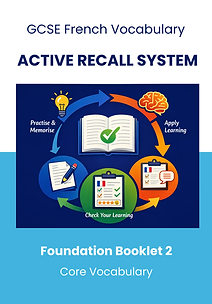
Booklet 1:
→ Me, family and friends
-
family members
-
personal information and physical description
-
personality
-
relationship, marriage and partnership
→ Technology
-
IT equipment and hardware
-
Using technology
→ Free time activities and going out
-
food and drink
-
meat and fish
-
fruit and vegetables
-
at the restaurant
-
free time and entertainment
-
sports
→ customs and festivals
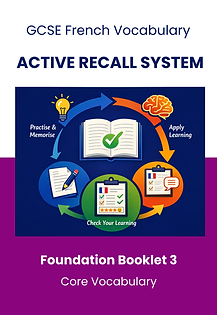
Booklet 3:
→ My studies
→ Life at school/college
→ Education post-16
→ Jobs and career
Booklet 2:
→ Home, town and region
-
home
-
what we wear
-
Shops and shopping
-
buildings and places
-
in town and countryside
→ Social issues
-
Health
-
Healthy eating
-
charity
→ Global issues
→ Travel and tourism
-
destinations/ nationalities
-
travel
-
holiday accommodation
-
holidays and activities


General Vocabulary
List for Memorisation: comparisons, conjunctions and connectives, prepositions, negatives, number expressions, questions, greetings & exclamations, opinions, seasons, time expressions, location and distance, weights measures and shapes, colours, weather, access, correctness, materials/

Why This Approach Works
Vocabulary only becomes secure when students retrieve it, apply it, and check their understanding. These booklets make that process simple and consistent. Because every student has their own printed copy, they follow the same clear strategy for revising vocabulary and can see their progress build over time.
The structure works because it:
-
turns vocabulary revision into short, repeated retrieval rather than passive review
-
gives students a clear method they can follow independently at home or in class
-
provides opportunities to apply vocabulary in context, strengthening recall and accuracy
-
includes built‑in review and self‑assessment so students can track what they know and what needs more practice
-
removes the guesswork for non‑specialists by providing ready‑made, reliable tasks
-
keeps revision consistent across all classes, reducing workload and increasing confidence
Watch video →
Download a free sample →
How the System Fits Into Everyday Teaching
The booklets are designed to work smoothly in lessons and at home, giving students a simple, reliable way to revise vocabulary without adding extra planning for teachers. Because each student has their own printed copy, the routine becomes consistent across the department.
They strengthen learning because they:
-
help students apply vocabulary in context, not just memorise lists
-
include short review tasks so learners can check and assess their progress
-
can be set as homework without any additional preparation
-
create a shared structure that works for specialists and non‑specialists
-
keep revision consistent across classes with minimal teacher workload
The Investment Logic
A One‑Time Departmental Investment — Reuse Every Year
Once purchased and downloaded, the only ongoing cost is reprographics. No per‑student workbooks. No annual renewals. No hidden fees.
Comparison
-
Workbooks: £6–£10 per student × 150 students = £900–£1500 every year
-
Active Recall System: One purchase. Unlimited use. Reusable annually.
Department Licence Price: £ 59.99