

Exploring TPRS: A Deep Dive into Teaching Proficiency through Reading and Storytelling
Updated: May 9
Today’s focus is TPRS (Teaching Proficiency through Reading and Storytelling).
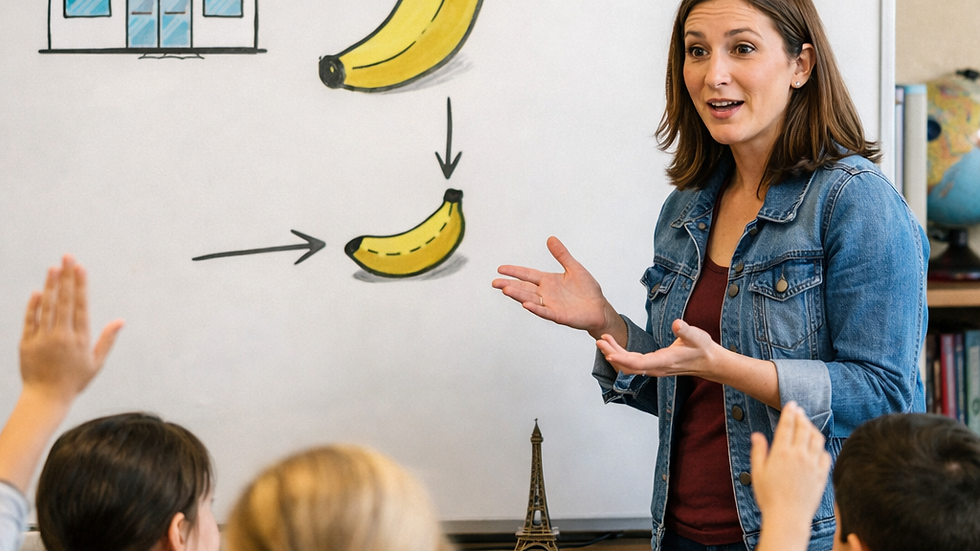
Understanding TPRS: What It Aims to Achieve
TPRS is a language‑acquisition method created in the late 1980s by Blaine Ray, a Spanish teacher who noticed that despite his best efforts, his students were making very little progress. Influenced by Stephen Krashen’s theories of second‑language acquisition, he developed a method built around one core belief:
"Students acquire language best when they hear and read lots of meaningful, understandable input, repeated in engaging ways."
Its goals are to:
Make input comprehensible.
Build fluency before accuracy.
Reduce anxiety.
Anchor language in memorable stories.
Create repetition that doesn’t feel repetitive.
It is not a grammar‑first approach. It is an input‑first approach that uses stories as the vehicle for acquisition.
How TPRS Works: Demystifying the Process
I’ll be honest: when I first encountered TPRS, I found the storytelling part confusing. I kept wondering:
“How can students answer questions about a story they haven’t read yet?”
“Are they supposed to guess?”
“Do they read the text first?”
It took me a while to realise that TPRS doesn’t work like a traditional comprehension task. The teacher isn’t testing students — the teacher is building the story with them. Once that clicked, the whole method made sense. Here is the accurate, classroom‑real sequence.
🎯 Step 1 — Establish Meaning (Properly, Not Superficially)
This step is much richer than “write the translation on the board”.
A TPRS teacher will:
Introduce 2–3 target structures.
Translate them.
Mime them.
Gesture them.
Act them out.
Check comprehension repeatedly.
Ensure students know the question words they will hear later.
This last point is crucial. If students don’t understand the key question words *— French: où, qui, quoi, quand, pourquoi, comment / Spanish: dónde, quién, qué, cuándo, por qué, cómo— circling collapses
Many TPRS teachers spend weeks training question words before doing full stories.
Example target structures (French) * **Example target structures (Spanish)*
veut aller (wants to go) quiere ir (wants to go)
cherche (is looking for) busca (is looking for)
trouve (finds) encuentra (finds)
Students learn the meaning through translation, gesture, and repetition.
🎯 Step 2 — Build the Story Orally (The Teacher Gives the Information First)
This is the part that confused me initially. Students do not need to know the answers in advance because: The teacher gives the information first, then circles it. Circling is not guessing. It is not prediction. It is not a quiz. It is repetition of information the teacher has just provided.
What “Circling” Actually Means
Circling simply means: The teacher takes one piece of information and asks several types of questions about it to create repetition. You “circle around” the same fact from different angles:
Statement
Yes/No
Either/Or
'Wh‑' Questions
Personalised
Next statement
Repeat the pattern
What Circling Might Sound Like

Teacher Gives the Information First
1st Teacher Statement: « Marie **veut aller** au supermarché. »
👉 Circling the Information
Yes/No: Est‑ce que Marie veut aller au supermarché ? → Oui.
Either/Or: Elle veut aller au supermarché ou au cinéma ? → Elle veut aller au supermarché.
Wh‑: Où est‑ce qu’elle veut aller? → Elle veut aller au supermarché.
Personalised: Et toi, où est‑ce que tu veux aller →Je veux aller au cinéma.
2nd Teacher Statement: « Marie **cherche** une banane géante. »
👉 Circling the New Information
Yes/No: Est‑ce que Marie cherche une banane géante → Oui.
Yes/No (negative check): Est‑ce que Marie cherche une petite banane → Non.
Either/Or: Elle cherche une banane géante ou une petite banane? → Une banane géante.
Wh‑ (object): Elle cherche quoi? → Elle cherche une banane géante.
Wh‑ (reason): Pourquoi est‑ce qu’elle veut aller au supermarché ? → Elle cherche une banane géante.
Yes/No (new detail): Est‑ce qu’elle trouve la banane géante? → Non.
Wh‑ (result): Qu’est‑ce qu’elle trouve → Elle trouve une petite banane.

Teacher Gives the Information First
1st Teacher Statement: « María *quiere ir al supermercado.
👉 Circling the Information
Yes/No: ¿María quiere ir al supermercado? → Sí.
Either/Or: ¿Quiere ir al supermercado o al cine? → Quiere ir al supermercado.
Wh‑: ¿Adónde quiere ir María? → *Quiere ir al supermercado.*
Personalised: ¿Y tú? ¿Adónde quieres ir? → Quiero ir al cine.
2nd Statement: « María *busca un plátano gigante.
👉 Circling the New Information
Yes/No: ¿María busca un plátano gigante? → Sí.
Yes/No (negative check): ¿María busca un plátano pequeño? → No.
Either/Or: ¿Busca un plátano gigante o un plátano pequeño? → Busca un plátano gigante.
Wh‑ (object): ¿Qué busca María? → Busca un plátano gigante.
Wh‑ (reason): ¿Por qué quiere ir al supermercado? → Porque busca un plátano gigante.
Yes/No (new detail): ¿Encuentra el plátano gigante? → No.
Wh‑ (result): ¿Qué encuentra? → Encuentra un plátano pequeño.
🎯 Step 3 — Reading (The Essential Half of TPRS)
Reading is not optional. It is half the method. Students read:
A written version of the story.
A parallel story.
An extended version.
Activities might include:
Translation.
Sequencing.
Comprehension questions.
Matching sentences to images.
Short dictation.
Reading consolidates the oral input.
🎯 Step 4 — Extensions (Only Once Comprehension is Secure)
Extensions reinforce the same structures in new contexts:
A new ending.
A class‑created version.
A comic strip.
A retell with sentence starters.
A listening gap‑fill.
A short writing frame.
⭐ The Golden Rule:
No new language — only new *contexts for the same language

What TPRS Gets Right ✅
High engagement and motivation, especially when stories are playful or slightly silly.
Massive exposure to high‑frequency structures.
Immediate comprehension success.
Natural repetition.
Strong listening and reading gains.
Low affective filter.
What to Keep in Mind with TPRS
Relies on teacher confidence and storytelling skill.
Requires dedicated preparation time; story creation takes time.
TPRS is not a ‘grab‑and‑go’ method, as much of the method relies on the teacher’s delivery and interaction with the class.
Limited explicit grammar focus.
Less aligned with KS4 exam demands.
Can challenge classroom management in lively groups.
⭐ Ideal for: KS3, lower prior attainers, confident storytellers, CI‑focused departments.
⭐ Less ideal for: KS4, non‑specialist‑heavy teams, tightly sequenced curricula.
How to Implement TPRS at Team Level (HoD Perspective)
Define its role clearly within your curriculum.
Train the team in circling.
Pair TPRS with other strategies.
Create a centralised TPRS resource bank that can grow over time.
Instead of every teacher reinventing stories or circling questions from scratch, the team gradually contributes to a central collection that everyone can draw from. This reduces workload, supports consistency, and makes the method more accessible for colleagues who are newer to TPRS.
A centralised bank might include:
Story scripts organised by year group and target structures.
Circling question sets for each script.
Reading versions (short, long, parallel stories).
Mini‑stories for quick practice.
Question‑word posters and visuals.
Common gestures for high‑frequency verbs and structures.
Model lesson videos recorded within the department.
Behaviour routines specific to storytelling lessons.
A glossary of agreed target structures for each year group.
Because TPRS is so teacher‑dependent, the goal isn’t to standardise delivery — it’s to standardise the scaffolding so teachers can personalise the performance without starting from zero. Over time, this becomes a living resource: something that grows, improves, and adapts as the team gains confidence.
What to Combine TPRS With (To Make It Sustainable)
Sentence Builders.
Retrieval Practice.
Explicit Grammar Teaching.
Exam‑aligned tasks.
CI‑based reading activities.
Useful TPRS Resources
TPRS Books (Blaine Ray) — story scripts, training, explanations https://tprsbooks.com.
Free sample story scripts https://tprsbooks.com/free-resources/.
Fluency Fast — What is TPRS? https://www.fluencyfast.com/what-is-tprs/.
Ben Slavic’s TPRS community https://www.benslavic.com.
YouTube demonstrations (French & Spanish) https://www.youtube.com/results?search_query=TPRS+French https://www.youtube.com/results?search_query=TPRS+Spanish.
Final Thoughts: The Balance of TPRS
TPRS can be powerful, engaging, and transformative. It is not a quick fix, and it is not a low‑prep method. It requires:
Training.
Shared planning.
Clear boundaries.
A realistic understanding of what it can (and cannot) deliver.
Used well, it can boost confidence, comprehension, and fluency, especially in KS3. Used alone, I am not convinced that it will prepare students for the full demands of KS4 (that's simply my view).
As with most things in MFL, the key is balance.
👉 Stay in the Loop
If you’d like to get future posts, you can subscribe and follow along as I explore each method.
👉 Browse My Classroom-Ready Resources
If you’re looking for practical MFL materials you can use tomorrow, feel free to explore my growing collection of resources.


Comments